
In this edition:
- When Construction Claims Meet the Courtroom
- Case Highlight: Airbag Manufacturing
Facility Claim - 5 Key Structural Mishaps in Aircraft/Spacecraft
Hangar Retrofit Projects for Construction-
Defect Defense Litigators
When Construction Claims Meet the Courtroom
By Stephen M. Rymal, P.E., Esq.
This is a follow-up article from the MDCAdvisor Summer 2026 Issue regarding the case of Dependable Mechanical Systems v. Ledcor Construction Limited, 2025 ONSC 5100 (CanLII).
The case involves the construction of a ten-story mixed-use condominium in Toronto, Canada. The owner contracted with Ledcor Construction Limited (Ledcor) on October 2, 2017, as the construction manager at risk on a fee-plus-cost basis. Substantial completion was scheduled for September 5, 2019, or 12 months later.
In turn, Ledcor subcontracted the mechanical work to Dependable Mechanical Systems (DMS) for the fixed price of $3,751,500.00, dated May 5, 2018. On January 2, 2020, Ledcor terminated DMS, and on January 6, Ledcor contracted with Zencorp to complete the mechanical work. The project was substantially complete on January 31, 2021.
The Court held that Ledcor proved that DMS failed to properly and diligently perform its work, thereby giving Ledcor the right to terminate the subcontract. But the Court didn’t stop there. It proceeded to examine in detail the issue of damages that Ledcor could recover from DMS to finish the work.
Ledcor submitted to the Court a detailed Schedule of Values for reimbursement.
Ledcor’s Damages Claim vs. Court Approval
Dependable Mechanical Systems v. Ledcor Construction Limited, 2025 ONSC 5100 (CanLII)
| Category | Amount (CAD) |
|---|---|
| Total Claimed | $5,551,890.76 |
| Court Approved | $2,445,685.15 |
| Difference (Not Awarded) | $3,106,205.61 |
The Court’s opinion is 37 pages long, and its discussion on damages alone was half of that, so this article will focus on the important takeaways.
The largest reduction was in Item No. 1 for Replacement Costs. The Court focused on the lack of credibility of the Ledcor witnesses and whether the work to complete by Zencorp was to be performed on a fixed-price, lump-sum, or time-and-material basis. Clearly, this was a critical error on the part of Ledcor, costing them over a million dollars.
The second-largest reduction was for delay costs in Item No. 2, in the amount of $953,167.50. The Court was concerned that Ledcor’s expert did not present a Critical Path Analysis.
The Court specifically stated that “the party seeking the delay claim must through the evidence isolate and define the delay, show that the delay affected the critical path of the project, and show that the other side was at fault for the delay as opposed to being excusably delayed.”
On the other hand, DMS’s expert employed the “impacted as-planned” method to attempt to show that DMS’s delay was as much the result of forces beyond its control as it was the result of DMS’s efforts.
As a result, DMS was able to identify several issues with Ledcor’s management, including permits, forming delays, and drywall delays, sufficient enough to highlight Ledcor’s failure to meet its burden of proof.
Regarding the majority of the remaining items, the Court was able to find sufficient evidence to merit granting Ledcor the claimed costs.
There were two final findings by the Court worthy of mention.
First, under Article 10.4(b), a determination needed to be made of the unpaid balance of the amount to be paid under the Subcontract received by the Owner.
The Court performed a detailed analysis of the holdbacks on the subcontract draws or invoices and the value of outstanding change orders.
The Court specifically applied the principle of quantum meruit to include unpaid work on unpriced and uncertified but legitimate extras that should be included in the unpaid balance under the Subcontract, despite the existence of Article 6, which required written authorization for any adjustment to the Subcontract price.
The Court had no difficulty finding that the owner paid Ledcor the balance due on the Contract, so the Court subtracted the Court-Approved Backcharges from the Unpaid Balance on the Subcontract, resulting in Ledcor actually paying DMS a little over $50,000, even though DMS was properly defaulted by Ledcor.
This result only serves to emphasize the value of having an expert perform a Critical Path Analysis to support Ledcor’s Backcharges. If Ledcor had done so, then this would have reversed this result.
The second finding of interest addressed by the Court was the fact that Ledcor had default insurance and recovered the entirety of its claim against DMS, less the deductible.
DMS argued that allowing Ledcor to recover damages for completing the Subcontract would amount to unacceptable double recovery or a windfall that the law does not allow.
However, the Court relied upon a prior Supreme Court of Canada decision that said the exception is based on fairness: a wrongdoer should not benefit from the private act of forethought and sacrifice of the plaintiff in obtaining private insurance.
The Court also noted that the insurance company did not exercise its right of subrogation and that the failure to exercise that right cannot affect the defendant’s liability for damages.
Key Takeaways for Construction Professionals
The case is full of important takeaways for the construction practitioner, but the prime focus of the Court’s attention during this trial was on its reliance on expert testimony, the credibility of the experts, and the need for a Critical Path Analysis supporting a delay claim.
Airbag Manufacturing Facility Claim
MDCSystems® Case Highlight
MDCSystems® was retained to provide consulting and expert witness services in connection with a $40 million defective design and construction claim involving an airbag manufacturing facility.
Following a catastrophic failure in the portion of the plant where explosive pellets were manufactured, MDCSystems® investigated the cause of the explosion.
The investigation determined that the failure resulted from the new owner’s operation of the facility rather than defective design or construction.
Computer animation demonstrated that an aluminum scoop dropped into a mixing machine created sparks that caused an explosive deflagration, while improperly stored product contributed to the severity of the event.
The analysis also demonstrated that the facility’s blow-out panels and ventilation ducting performed as intended.
The case settled favorably for the client immediately following the release of MDCSystems®’ animated reconstruction.

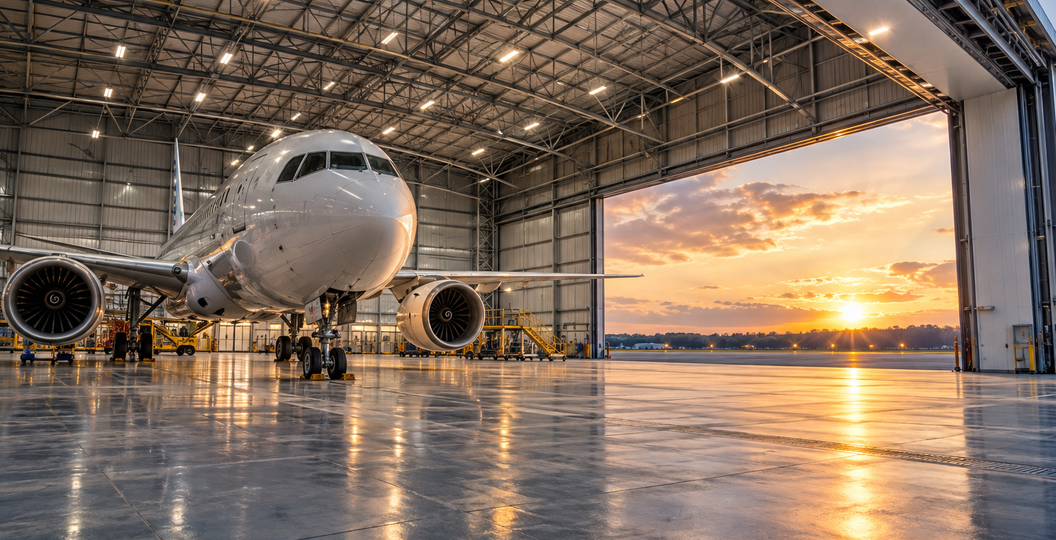
5 Key Structural Mishaps in Aircraft/Spacecraft Hangar Retrofit Projects for Construction-Defect Defense Litigators
By Vanessa Malone, P.E.
Aircraft and spacecraft hangars are structurally unique facilities designed to maintain, store, and protect aircraft and spacecraft. Their massive clear-span framing, oversized doors, reinforced foundations, fire-protection systems, and exposure to heavy loads create distinct design and retrofit challenges.
For construction-defect defense litigators, determining the causation—and ultimately liability—of a construction defect can be complex.
Engaging construction-defect and structural forensic engineering experts early can help determine causation, reduce risks, and limit costs.
Below are five key structural blind spots to consider in hangar renovation projects.
1. Long-Span Cable Distress
Hangars require large, unobstructed spaces supported by long-span beams, trusses, girders, arches, cables, and framing systems.
Because of these long spans, the systems can be particularly sensitive to corrosion, connection issues, excessive deflection, vibration, roof ponding, overload, and unexpected suspended loads.
Signs of structural distress can include damaged or slack cables, stretched bolts, cracked welds, bowing or out-of-plumb columns, corroded base plates, and shifting connections.
Because long-span systems have relatively limited redundancy, smaller issues should be addressed before they develop into larger structural problems.
2. Wind-Load Resistance
Hangars located in high wind-risk areas must maintain structural integrity while protecting aircraft and spacecraft from hurricanes, tropical cyclones, and other windstorms.
Wind loads directly impact a building’s Lateral Force Resisting System (LFRS) and overall stability, making wind resistance especially important when retrofitting older structures.
Potential warning signs include inadequate hurricane connections, loose roof decking or wall panels, deteriorated fasteners, discontinuous load paths, sagging roof lines, leaning columns, damaged anchor bolts, fractured welds, and structural cracking.
3. Ponding / Poor Roof Drainage
Hangars have exceptionally large roof areas that require sufficient drainage through internal drains, scuppers, gutters, and other systems.
Debris blockage, insufficient roof slope, or deformed underlying framing can contribute to ponding and further deterioration.
Poor drainage can result in standing water, sagging roof decks, water intrusion, corrosion, damaged flashing, and deteriorated structural connections.
Excessive water weight from ponding can overload the roof structure and eventually contribute to leaks, structural damage, and potential roof failure.
4. Concrete Carbonation
Hangar slabs routinely support tremendous concentrated loads from aircraft and spacecraft.
In older structures, concrete carbonation can become an important concern during renovation.
Carbonation occurs when atmospheric carbon dioxide reacts with hardened concrete, reducing its pH and weakening the protective environment surrounding reinforcing steel, which can lead to corrosion.
Warning signs may include chalky concrete surfaces, rust-colored staining, cracking, spalling, delamination, and hairline cracks.
A qualified structural forensic expert should evaluate structures displaying signs of concrete carbonation.
5. Existing Building Movement
Existing hangars naturally experience structural movement over time, including creep, shrinkage, thermal movement, differential floor or slab deflection, and settlement.
These conditions can worsen with changing loads, continued use, and exposure to weather.
Signs of differential movement may include severe slab cracking, warped flooring, cracking at structural connections, sticking windows or doors, and separation of rigid partitions.
A qualified structural engineer should evaluate signs of significant structural movement before they develop into more serious structural issues.
Addressing Structural Issues Early
Structural defects involving long-span framing, wind resistance, roof drainage, concrete deterioration, or building movement can become increasingly complex and costly if left unaddressed.
For construction or design defects involving structural components, engaging construction-defect and structural forensic engineering experts early can help determine causation, reduce risks, and limit costs.
Preeminent Solutions specializes in structural forensics and construction-defect expert witness work.
Contact us for your next aircraft and/or spacecraft hangar construction-defect case.



0 Comments